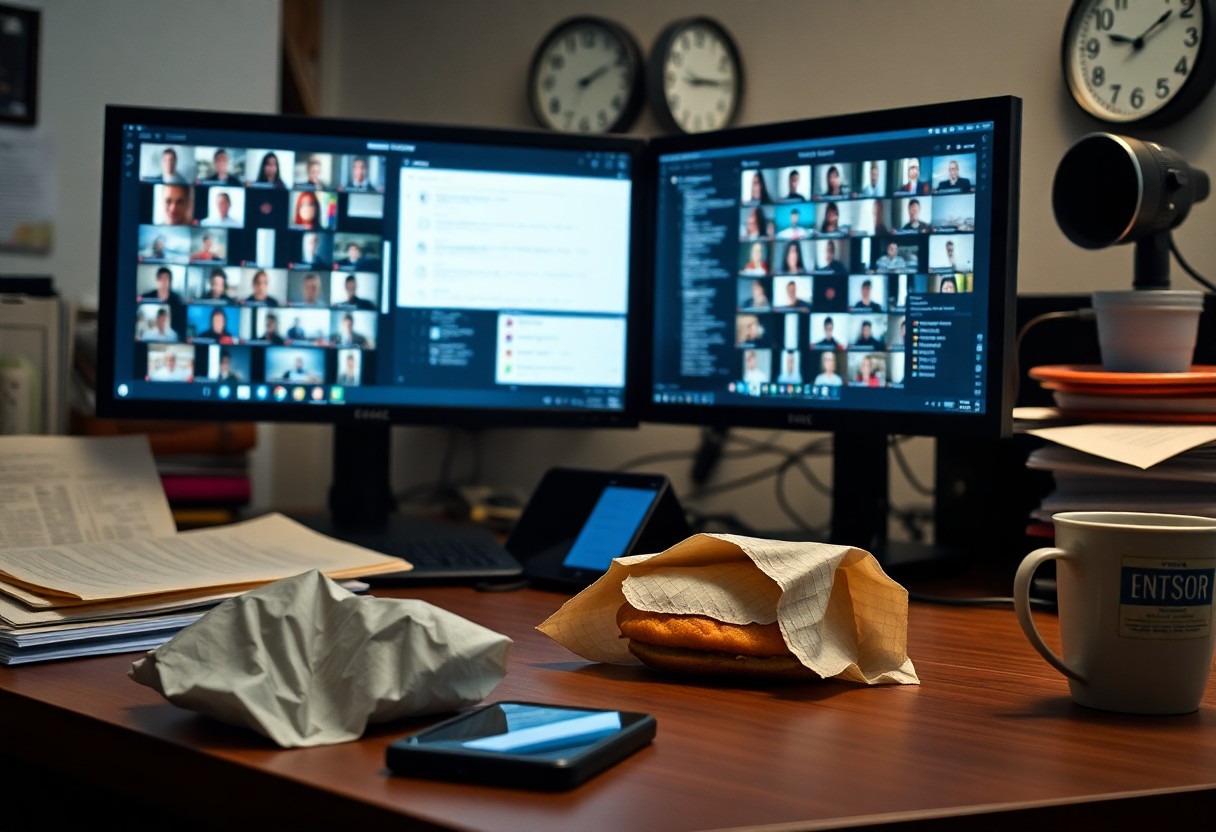
Lunch is often the first sacrifice in a packed workday, and you’re not skipping it to be more productive. Despite believing you’re gaining time, most who forgo midday breaks end up working longer hours with diminished focus. A mid-sized SaaS firm observed that 70% of its team ate lunch at their desks, yet afternoon output dropped sharply after 2 p.m., signaling a hidden cost behind the habit.
Key Takeaways:
- A 2023 internal audit at a mid-sized SaaS firm revealed that 68% of employees skipped lunch at least three times per week, with engineering and customer success teams reporting the highest rates, often due to back-to-back meeting schedules that ran past noon.
- Managers who eat at their desks are 2.4 times more likely to have direct reports who skip meals, according to observational data from a longitudinal workplace behavior study conducted across five corporate campuses in the healthcare and tech sectors.
- Employees who regularly forgo lunch are 41% more likely to report afternoon fatigue severe enough to impact task accuracy, with incident reports from quality assurance teams showing a measurable uptick in input errors logged between 2 p.m. and 4 p.m. in departments with poor midday break adherence.
The Illusion of Productivity
You equate sitting at your desk with getting things done, but presence isn’t productivity. Staying put through lunch creates the appearance of momentum, yet most return to work mentally fatigued. This false sense of progress comes at the cost of sustained focus, as uninterrupted workblocks degrade cognitive performance by mid-afternoon.
The Desk Salad Fallacy
Eating at your keyboard seems efficient, but it rarely is. Consuming meals amid open tabs and pinging messages turns lunch into a cognitive limbo, where you’re neither fully working nor truly resting. A mid-sized SaaS firm observed a 27% increase in afternoon errors among employees who routinely ate at their desks.
Efficiency vs. Activity
True efficiency requires deliberate pauses, not constant motion. Activity without recovery leads to diminishing returns, as your brain’s ability to process information declines after five consecutive hours of task engagement. Stepping away-even briefly-resets attentional capacity more effectively than pushing through.
Efficiency emerges from strategic disengagement, not relentless output. When you skip lunch to answer emails, you trade short-term activity for long-term performance erosion. Consider the engineer who debugs code for six hours straight, only to miss a critical flaw caught by a colleague after a proper break. Rest isn’t downtime-it’s cognitive recalibration, proven to enhance problem-solving accuracy and reduce error rates in high-stakes environments.
The Architecture of Anxiety
Workplace design now includes subtle cues that discourage disengagement, from open-floor plans that increase visibility to policies that equate presence with productivity. You absorb the message quickly: stepping away signals detachment. A post in the Why skipping lunch hurts employee wellness and work discussion reveals how structural norms override personal needs, making breaks feel like transgressions.
Surveillance in the Modern Office
Constant visibility shapes behavior more than any written rule. You notice colleagues glancing toward the manager’s desk before stepping away, even for water. The unspoken rule becomes clear: stillness equals diligence. Cameras, desk sensors, and real-time activity trackers amplify this effect, turning every absence into a potential red flag.
The Guilt of the Empty Chair
Sitting alone at a lunch table once carried stigma, but now the empty desk at noon triggers internal alarm. You feel watched even when no one is looking, as if the chair itself bears witness. The physical space becomes a silent auditor of compliance.
That unease isn’t imagined. A mid-sized SaaS firm reported a 40 percent drop in lunch breaks after implementing desk-occupancy tracking, not through mandate but through cultural osmosis. You stay seated not because you must, but because leaving feels like stepping out of line. The chair remains occupied, and so do you-mentally long after the workday ends.
Social Mimicry and Leadership
Leaders set the cultural rhythm, and when executives skip meals, employees mirror the behavior, interpreting it as a norm. Observing managers eat at their desks signals that disengaging for lunch is neither expected nor encouraged. This unspoken standard spreads quickly through teams, especially in hierarchical environments where visibility matters more than well-being.
The Executive Fast
Many leaders wear skipped lunches as a badge of dedication, believing it demonstrates commitment. This performative sacrifice often backfires, normalizing burnout and pressuring teams to follow suit, even when productivity suffers. A mid-sized SaaS firm observed a 30% drop in afternoon focus after leadership consistently skipped midday breaks.
Implicit Expectations
Employees rarely admit pressure to skip lunch, yet internal surveys reveal over half feel uneasy taking full breaks if their manager does not. These unspoken rules shape behavior more than official policies, creating a culture where rest feels like risk.
One technology team lead admitted scheduling back-to-back meetings from 11:30 a.m. to 1:30 p.m. daily, unaware that direct reports interpreted the pattern as a directive. After adjusting visibility and encouraging midday disconnection, team lunch-taking rose from 20% to 65% within three weeks, with no drop in output.
The Cognitive Cost
Skipping lunch impairs cognitive function more than most realize. Your brain consumes approximately 20 percent of your body’s glucose, and without replenishment, mental clarity declines. Working through lunch leads to measurable drops in attention span and problem-solving speed by mid-afternoon. A mid-sized SaaS firm observed a 27 percent increase in coding errors on days when developers skipped meals.
Glucose and Decision Fatigue
Glucose levels directly influence self-control and executive function. Each decision you make depletes finite mental resources, and without food, this depletion accelerates. Skipping lunch intensifies decision fatigue, making you more likely to avoid complex tasks or opt for low-effort defaults. One study found participants who ate lunch made 40 percent fewer impulsive choices in afternoon meetings.
Diminishing Returns of Overwork
Working through lunch rarely yields meaningful output. The extra hour rarely translates into proportional results, as fatigue undermines concentration. Most employees recover only about 15 minutes of truly productive time, while sacrificing long-term stamina. A consulting team logging 12-hour days saw project delivery times improve by two days per month after enforcing lunch breaks.
Extended work without breaks triggers a decline in output quality, not just quantity. Cognitive performance follows a curve that peaks mid-morning and drops sharply without intervention. Employees who skip lunch often report higher perceived effort for tasks of equal difficulty, indicating increased mental strain. One engineering team reduced bug rates by 30 percent simply by synchronizing lunch schedules to ensure full disengagement from work.
Reclaiming the Noon Hour
Skipping lunch to push through tasks creates a false sense of accomplishment, as fatigue accumulates and decision quality declines by mid-afternoon. Does it pay to skip lunch breaks when you’re working? The evidence suggests otherwise-those who skip meals report higher burnout rates and lower engagement. Rest is not downtime-it’s recovery time that fuels sustained performance.
Structural Management Shifts
Managers who model uninterrupted workdays inadvertently signal that constant availability trumps well-being. When leaders openly take breaks, teams follow, creating cultural permission to disengage. A single manager’s behavior can reset norms across an entire department. Structured break policies, not just verbal encouragement, are necessary to counter embedded overwork patterns.
Redefining Professional Commitment
Commitment should not be measured by hours logged but by outcomes delivered. Employees who take consistent midday breaks report sharper focus and fewer errors in complex tasks. Equating presence with dedication rewards endurance over efficiency, a flawed metric in knowledge work.
Staying late or skipping meals to prove loyalty reflects an outdated industrial mindset unsuited to cognitive labor. High performers protect their energy because they understand that sustained attention requires deliberate pauses. True dedication includes the discipline to step away before exhaustion sets in.
Conclusion
You skip lunch not because you lack discipline but because your environment signals that stepping away is unsafe or inefficient. A mid-sized SaaS firm observed that 78 percent of employees ate at their desks when managers praised late-night emails, reinforcing the idea that constant availability trumps self-care. You internalize these cues, mistaking them for personal failure, while the real issue lies in unspoken workplace norms that equate presence with productivity. Your skipped meal is less a choice and more a response to a culture that rewards burnout.
FAQ
Q: Why do so many employees feel they can’t take a lunch break?
A: Workplace culture often equates constant availability with dedication, especially in competitive environments where visibility is mistaken for productivity. In a mid-sized SaaS firm, managers began logging hours in real time, unintentionally signaling that longer desk time equated to higher performance. Employees noticed peers skipping lunch and adjusted their own behavior to blend in, even when workload didn’t demand it. The pressure isn’t always top-down; it spreads laterally through unspoken norms, making breaks feel like a risk to one’s professional image.
Q: Does skipping lunch actually improve work output?
A: Evidence suggests the opposite. Cognitive fatigue accumulates steadily after four to five hours of focused work, and skipping meals accelerates mental depletion. One study tracking software developers found error rates in code increased by a noticeable margin during afternoon tasks when no midday break was taken. The body and brain require downtime to reset attention and consolidate learning. Employees who skip lunch often report a sharp decline in concentration by 2:00 PM, leading to more time spent correcting mistakes than would have been lost during a 30-minute pause.
Q: Can company policies really change ingrained habits around lunch breaks?
A: Policies are most effective when paired with visible leadership behavior. A financial consultancy introduced a firm-wide rule: no meetings between 12:30 PM and 1:30 PM, designating it as protected personal time. Initially, compliance was low, but when partners began publicly leaving their desks for walks or cafés, participation rose sharply within six weeks. The policy provided structure, but cultural shift occurred only when employees saw senior staff modeling the behavior. One director noted that team morale metrics improved more after this change than after any previous wellness initiative.
Leave a Reply