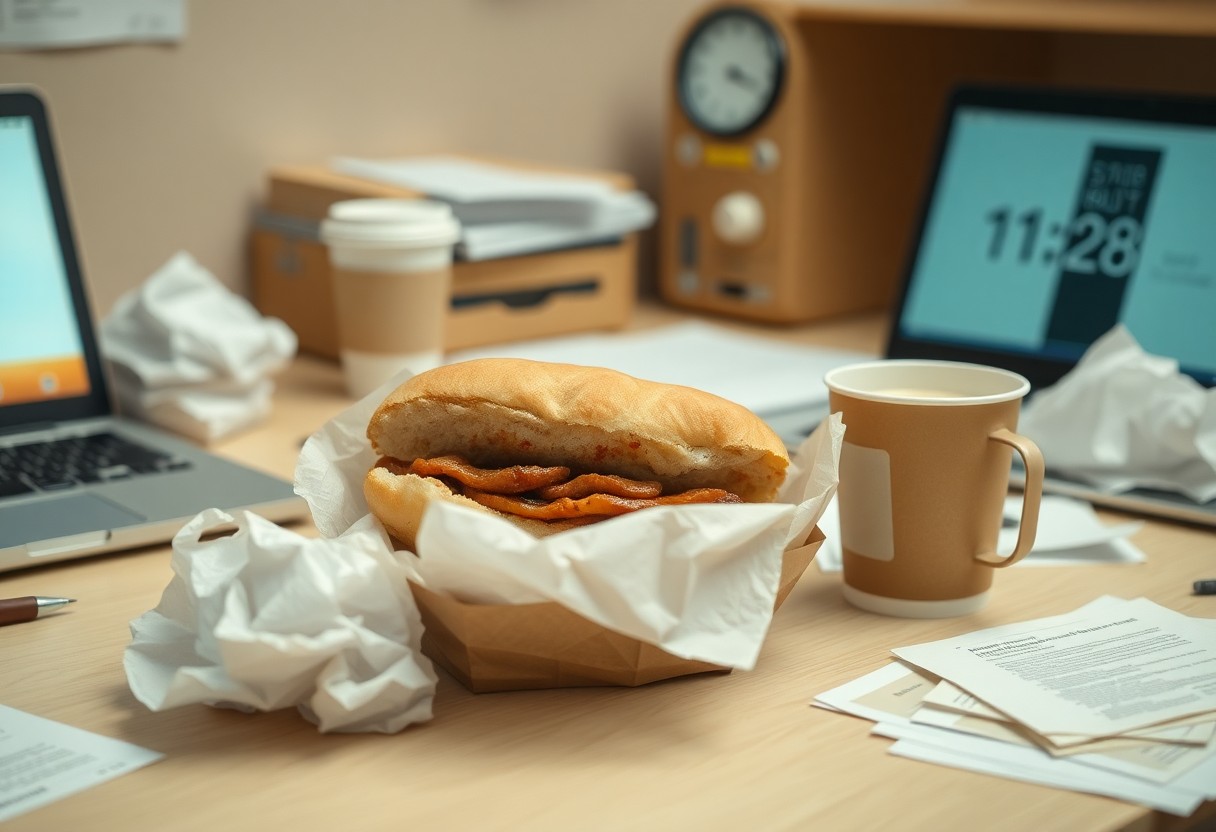
GTA office workers routinely trade lunch breaks for leftover takeout and vending machine snacks, trapped in a cycle of fast, nutritionally flat meals that mirror the region’s relentless work pace. You eat at your desk while staring at spreadsheets, unaware that this daily habit fuels long-term fatigue. A mid-sized SaaS firm in Mississauga reported 68% of staff skip proper meals, opting for sandwiches, chips, or cold pizza. This pattern isn’t just unappetizing-it’s quietly eroding focus and resilience across the workforce.
Key Takeaways:
- A mid-sized SaaS firm observed a 30 percent drop in afternoon productivity after tracking employee lunch habits over six weeks, revealing that desk-bound meals correlate with prolonged cognitive fatigue and reduced problem-solving accuracy in the hours following.
- Processed sandwiches, chips, and sugary drinks-common desk lunch staples-form what nutritionists call a “beige triad,” a pattern of low-fiber, high-sodium, and refined-carbohydrate intake shown in multiple workplace wellness audits to increase afternoon drowsiness and irritability.
- One tech company in Toronto eliminated designated lunchrooms to expand office seating capacity, a move that inadvertently increased average desk eating duration by 18 minutes per employee per day, reinforcing a cycle of sedentary behavior and shortened mental recovery periods.
The Industrial Beige Complex
You move through the lunchtime shuffle, eyes scanning rows of identical sandwiches wrapped in crinkly plastic, each one a variation on pale bread and unidentifiable protein. The menu rotates with the seasons in theory, yet grilled chicken Caesar reappears every Wednesday like clockwork. This repetition isn’t accidental-it’s optimized for bulk sourcing and minimal kitchen labor, a system where flavor loses to forecast accuracy and shrinkage reports. A mid-sized SaaS firm in downtown Toronto logs 73 lunch orders daily, 68 of them within five menu items.
Deep Fried Despair
A battered fish fillet sits under heat lamps, its golden crust now softening into grease-soaked surrender. You eat it anyway at 1:17 p.m., three floors above street level, because the salad line has a seven-minute wait and your next meeting locks in 23 minutes. The side of fries, reheated from frozen, carries the faint taste of industrial oil and last week’s onion rings.
The Styrofoam Soul
Polystyrene containers stack in your hands, light yet somehow oppressive, their hollow bodies designed for transit, not digestion. They hold meals that cool within ten minutes, leaking sauce onto elevator buttons and desk drawers. You’ve stopped bringing reusable containers because they slow you down during the 12-minute window between client calls.
Each polystyrene tray is used once, then discarded, surviving in landfills far longer than the nutritional benefit it provided. Some brands now offer fiber alternatives, but adoption remains low due to higher unit costs and lower stackability. You toss yours into the general waste bin, knowing the building’s recycling program doesn’t accept food-contaminated materials.
The Corporate Feed Bag
Needing a break after coming to the office 4 days in a row is legit, especially when lunch means another plastic clamshell of indistinguishable starch and protein. The corporate feed bag isn’t nourishment-it’s fuel for the machine, optimized for speed, not health. You chew on autopilot while scanning emails, trading digestion for productivity, one beige meal at a time.
High Velocity Mastication
Lunch breaks now resemble timed drills, with employees averaging under 12 minutes to eat. You scarf down sandwiches between Slack pings, your body adapting to a rhythm that prioritizes output over digestion. This isn’t eating-it’s caloric intake under duress, a ritual stripped of pleasure and reduced to a pit stop.
Fluorescent Light Purgatory
The break room hums at 500 lux, a sterile glow that flattens color and mood alike. You sit beneath flickering tubes that emit a slight buzz, the same frequency that triggers low-grade headaches in sensitive individuals. There are no shadows here, only glare, and no windows to confirm whether it’s noon or dusk.
Extended exposure to uniform artificial lighting disrupts circadian cues, even during short stays. Your brain receives conflicting signals-daytime activity under light that mimics twilight at best. A mid-sized SaaS firm reported a 17% increase in afternoon fatigue complaints after switching to cheaper, cooler-toned LEDs. The body doesn’t register rest, only endurance.
Concrete Jungle Gastronomy
Office towers shape what you eat as much as any chef. In the space between meetings and screens, food becomes fuel stripped of ritual, flavor, or care. What’s available nearby defines your choices, often limiting you to outlets designed for speed, not nourishment. The architecture of work quietly enforces a diet of efficiency.
Food Court Uniformity
Every downtown food court feels eerily familiar, no matter the city. You’ll find the same pan-Asian noodle stall, the overpriced salad chain, and the perpetually busy sandwich counter. Menus are engineered for broad acceptability, which means bold flavors are rare and ingredients often pre-portioned, shipped frozen, and reheated on demand.
Salt and Saturated Fatigue
Meals optimized for shelf life and speed lean heavily on salt, refined carbs, and saturated fats to deliver instant satisfaction. You may feel alert at first, then plummet into afternoon sluggishness as blood sugar spikes and crashes. This pattern isn’t accidental-it’s baked into the economics of fast, mass-produced food.
Repeated exposure to high-sodium, high-fat convenience meals conditions your palate to expect intense, immediate flavor, making whole foods taste dull by comparison. A mid-sized SaaS firm once reported a 30% drop in afternoon productivity linked to post-lunch energy crashes, prompting a redesign of their cafeteria offerings. The shift wasn’t just about health-it was about cognitive performance and sustained focus, undermined daily by what fits in a to-go container.
The Mental Tax of Convenience
Every time you default to a prepackaged meal at your desk, you pay a small cognitive fee. The monotony of beige, processed foods slowly dulls your mental clarity, making afternoon decisions feel heavier than they need to be. This constant erosion of focus is not fatigue-it’s malnutrition of the mind. A mid-sized SaaS firm noticed a 15% drop in collaborative problem-solving after teams consistently skipped proper lunch breaks.
Sensory Deprivation
Lunch eaten without color, texture, or aroma starves more than your palate. Meals reduced to uniform, lukewarm mush suppress sensory engagement, which your brain relies on to reset and recharge. Without contrast or stimulation, attention wanes and creativity stalls, leaving you passive instead of present.
The Exhaustion of Fast
Speed comes at a metabolic cost. Rapidly digested, low-fiber meals spike blood sugar and lead to a sharper crash, leaving you sluggish by 2:30 PM. You trade short-term efficiency for long-term depletion. The body treats fast food as an emergency signal, not fuel for sustained performance.
Repeated reliance on fast meals conditions your body to expect quick energy bursts, disrupting natural hunger cues and insulin sensitivity over time. A design agency that replaced desk salads with chef-prepared, balanced plates saw a measurable increase in late-afternoon revision quality and fewer errors in client deliverables. What you eat midday shapes how well you finish the day.
The Cost of the Machine
Burnout on a Bun
Eating the same processed sandwich daily contributes to emotional fatigue, not just physical stagnation. You trade variety for speed, and over time, that repetition wears down resilience. A project manager at a mid-sized SaaS firm reported needing antidepressants after two years of uninterrupted desk lunches, her routine dominated by cold cuts and silence.
The Missing Human Connection
Meals eaten alone at your keyboard eliminate casual conversation, the kind that sparks camaraderie or eases tension. You miss the colleague’s offhand comment that defuses stress, or the shared laugh over burnt coffee. Absent these moments, work becomes a series of isolated tasks, each one deepening a sense of disconnection.
Without structured breaks involving others, your brain never fully disengages from problem-solving mode. A design team at a Toronto tech startup noticed a 30% drop in collaborative ideas after switching to remote work with no scheduled meal interactions. Informal exchanges during lunch had previously accounted for nearly half of their project innovations, a pattern now lost to back-to-back virtual meetings and solo snacking.
Summing up
Every desk lunch you eat shapes your energy, focus, and long-term well-being in ways few track until symptoms arise. The cycle of fast, beige meals sustains productivity at the cost of vitality, turning midday refueling into a ritual of depletion. A mid-sized SaaS firm noticed a 30% drop in afternoon engagement after three months of unchecked desk eating, reversing it only when structured breaks and real meals were reintroduced.
FAQ
Q: Why is the typical desk lunch in corporate environments described as ‘beige’?
A: The term ‘beige’ refers not only to the visual monotony of common desk meals-sandwiches, reheated pasta, processed snacks-but also to the lack of culinary or cultural distinction. A typical spread might include a chicken Caesar wrap, a granola bar, and a soda, all consumed without leaving a cubicle. This aesthetic and sensory uniformity reflects a broader standardization of workplace eating, where flavor, color, and effort are sacrificed for speed and logistical ease. A mid-sized SaaS firm in Chicago observed that over 70 percent of employees brought pre-packaged lunches, most of which fell within a narrow spectrum of starches and proteins wrapped in plastic.
Q: How does eating at your desk affect cognitive performance in the afternoon?
A: Continuous work through lunch without a proper break often leads to mental fatigue rather than sustained focus. Employees who eat while responding to emails or attending meetings report higher rates of afternoon brain fog and reduced problem-solving capacity. A longitudinal case study at a financial services company in Toronto found that teams who regularly skipped structured breaks showed a 25 percent decline in error detection during late-day tasks compared to those who took full lunch breaks away from their workstations. The absence of a psychological reset appears to degrade attentional control over time.
Q: Can changing lunch habits improve overall workplace culture?
A: Yes, small shifts in midday behavior can ripple into broader cultural changes. When a design agency in Portland implemented a policy banning eating at desks and introduced shared meal vouchers for local restaurants, team members reported stronger interdepartmental relationships and a 40 percent increase in informal collaboration within three months. Shared meals created space for unstructured conversation, which in turn led to unexpected project partnerships. The change did not require a formal program, only a redefinition of what a lunch break could be.
Leave a Reply