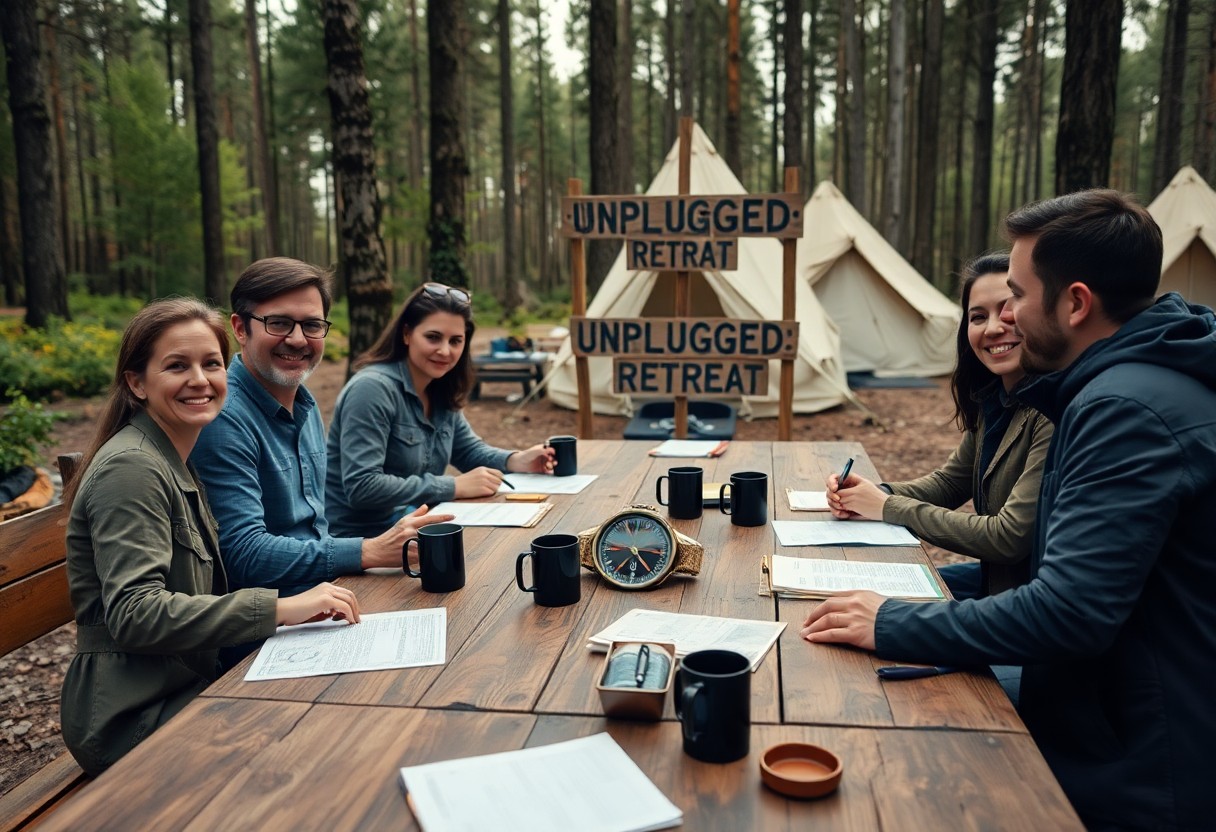
Workplace stress and constant connectivity erode performance; when you run an unplugged team retreat you create space for deep focus and candid connection, reduce the threat of digital burnout, safeguard your team’s mental health, and generate renewed creativity, stronger cohesion, and measurable productivity gains that improve collaboration and retention.
Key Takeaways:
- Unplugged retreats deepen team connection and psychological safety, strengthening trust and collaboration.
- Device-free time restores focus and creativity, helping teams surface clearer priorities and better solutions.
- Structured, tech-free agendas with shared reflection and nature-based activities boost well-being and sustained productivity.
Understanding the Concept of Unplugged Retreats
Unplugged retreats are deliberate, time-bound breaks from screens and inboxes so you can rebuild in-person connection, usually over 48-72 hours with a mix of facilitated workshops, outdoor activities, and reflection rituals. You trade constant notifications for structured dialogue and practice; many programs pair pre- and post-retreat surveys, and organizations report 70-85% of participants noting clearer priorities and stronger interpersonal bonds afterward.
Definition and Purpose
An unplugged retreat removes digital distractions to accelerate team alignment and psychological safety: you convene offsite for focused collaboration, typically 2-4 days, with goals like strategic planning, conflict repair, or leadership development. Facilitators guide activities-silent walks, role-play, and debriefs-so you can convert surface-level rapport into actionable norms and measurable outcomes via baseline metrics and follow-up checks.
Benefits for Team Dynamics
You see rapid improvements in trust, communication, and decision speed when people engage face-to-face without devices: teams often report a 20-40% lift in perceived trust and a notable drop in miscommunications in post-retreat surveys. Shared rituals and real-time feedback let you practice hard conversations, shortening project cycles and reducing rework.
One practical example: a mid-size SaaS team ran a 3-day unplugged retreat with structured conflict-resolution drills and a rotating-facilitator model; within a quarter they cut cross-team handoff delays by ~30% and logged a 60% reduction in after-hours emails the week following the retreat, showing how behavioral changes translate into measurable operational gains.
The Impact of Technology on Work Culture
Every day your team navigates an ecosystem of constant messages, cloud tools, and always-on expectations that reshape norms and recovery windows. France’s 2017 “right to disconnect” and the WHO recognizing burnout in ICD‑11 (2019) reflect systemic pushback, while firms like Basecamp and Volkswagen experiment with delayed email delivery to reduce after‑hours pressure and protect your focus.
The Need for Disconnection
When you step away from devices, your attention and decision‑making recover quickly; even a single device‑free retreat day can reset cognitive bandwidth. Companies that formalize breaks-Patagonia’s time‑off culture or Basecamp’s strict asynchronous rules-show how policy and practice combine to give you predictable recovery windows and fewer reactive interruptions during deep work.
Stress and Burnout in Modern Work Environments
Burnout is classified by WHO as an occupational phenomenon (ICD‑11, 2019), and a Gallup survey found about 44% of workers report frequent burnout symptoms, which directly undermines engagement and retention. When you’re reachable around the clock, emotional exhaustion and reduced performance follow, driving lost productivity and higher turnover risk for your organization.
Physiologically, chronic work stress elevates cortisol, disrupts sleep, and degrades memory and immune response, making recovery non‑negotiable. Practical evidence shows policy works: Microsoft Japan’s 2019 four‑day workweek pilot yielded roughly a 40% productivity boost and improved wellbeing metrics, demonstrating that structured disconnection can both protect your health and enhance outcomes.
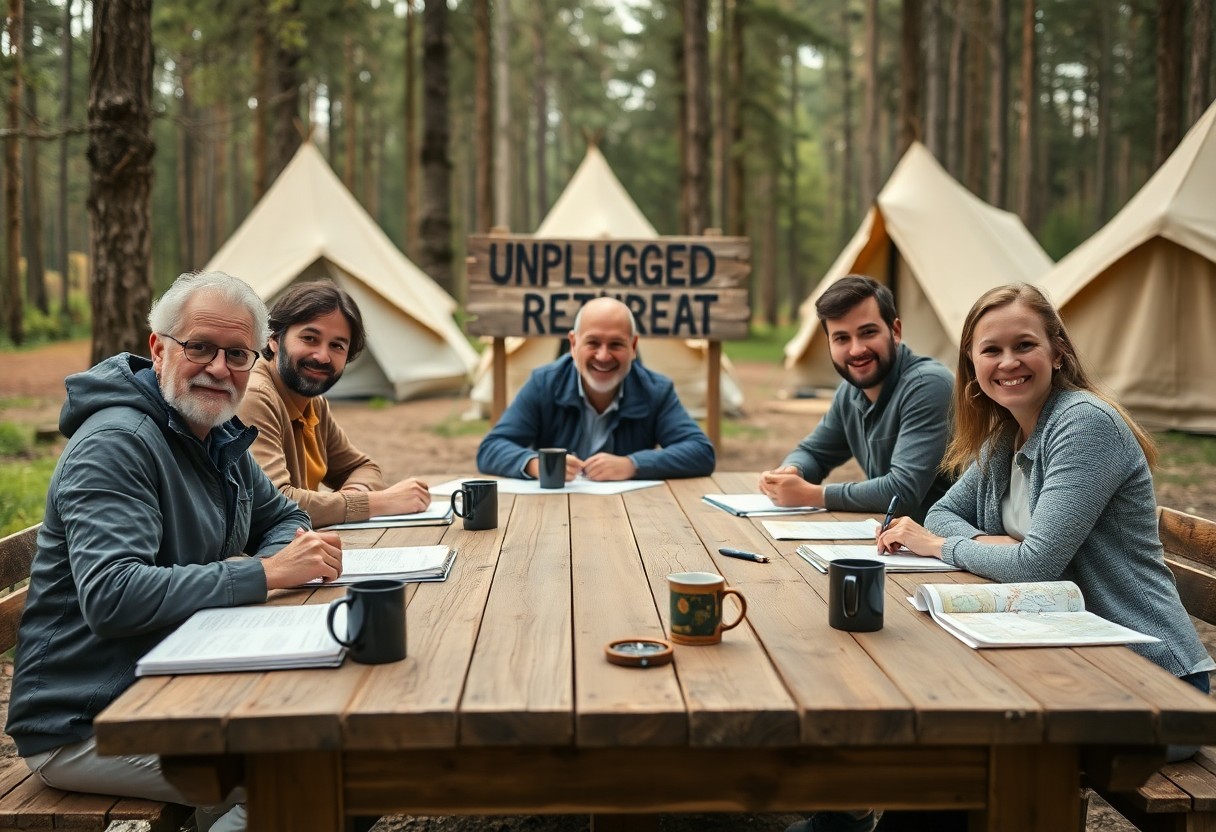
Planning an Effective Unplugged Retreat
When planning, aim for a 2-4 day retreat with 8-20 participants to balance depth and manageability, and budget roughly $300-$900 per person/day depending on lodging and activities. Build an agenda that alternates device-free blocks and structured reflection, assign roles for facilitation, and establish a clear emergency protocol. For venue and logistics examples, see Remote Coworking & Wellness Retreat in Chile | Work Well.
Setting Clear Objectives
You should set 3-5 measurable objectives before you leave: for example, increase cross-team project alignment by 30%, cut recurring meetings by 20%, or raise psychological safety scores on your post-retreat survey. Share objectives with participants, map sessions to each goal, and assign lead facilitators. A typical approach is one 90-minute workshop per objective plus daily reflection slots so you can capture baseline and follow-up metrics within 30 days.
Choosing the Right Location
Pick a site that supports your goals: cabin-style lodges for immersive bonding, co-working farms for creativity, or beachfront centers for low-stress reflection. Confirm capacity for your full group, meeting rooms, and backup heating or shade. Also weigh transfer times-aim for locations within 1-2 hours of an airport to reduce logistics friction and ensure timely emergency access.
You should vet seasonal weather, local medical facilities, and cell coverage before booking; if the area has no cell signal, plan a satellite or single emergency hotspot and share evacuation routes with your team. Confirm catering capabilities, dietary accommodations, and any permits for off-site activities. Prioritize locations with a local coordinator who can handle logistics so you can keep the retreat focused on outcomes, not troubleshooting.
Activities that Foster Team Cohesion
Mix high-energy challenges with reflective practices to deepen bonds: short, structured sessions of 45-90 minutes like problem-solving sprints, paired storytelling, and silent nature walks build different muscles of collaboration. Google’s Project Aristotle found that group dynamics such as psychological safety predict team performance, so you should sequence activities to scaffold trust rather than only entertain-otherwise well-intentioned games can increase tension.
Team-Building Exercises
Use concrete formats: a 60-90 minute escape-room or ropes-course followed by a 30-minute facilitated debrief, a 90-minute collaborative cooking challenge, or a 4-hour mini-hackathon with cross-functional pairs. Keep groups to 4-8 people, rotate roles, timebox tasks, and capture outcomes with a quick post-activity survey; without a structured debrief you risk amplifying misunderstandings instead of resolving them.
Mindfulness and Reflection Sessions
Integrate short, repeatable practices-10-20 minute guided meditations, 15-minute silent walks, and 10-minute journaling prompts-alongside an optional 8-week MBSR-style sequence for deeper change. These practices reduce stress and sharpen attention, and work best when paired with a brief group share (6-12 people) to translate personal insights into team-level adjustments.
Practical setup: start mornings with a 15-minute body-scan, add a 20-minute silent nature walk mid-retreat, then hold a 30-minute guided reflection using prompts like “What energized you?” and “What barriers did you notice?” Track impact with pre/post measures (Perceived Stress Scale, brief psychological-safety items on a 1-5 Likert) and a 3-question pulse after each session to iterate content and facilitation.
Measuring the Success of Retreats
Use both immediate signals and longer-term metrics to measure success: you should run post-retreat surveys within 48 hours to capture emotional shifts, track an action-plan completion rate (target 80% within 90 days), and monitor KPIs like cycle time, NPS, or retention for 3-6 months to link retreat outcomes to performance; for example, one 50-person team logged a 30% drop in missed deadlines and a 12% engagement score rise after two unplugged retreats paired with follow-up coaching.
Feedback and Follow-up
Collect feedback within 48 hours using Likert items plus three open prompts and an NPS-style question to quantify sentiment, then assign owners, set deadlines, and run 1:1 check-ins at 2 and 8 weeks; if you fail to convert insights into assigned tasks you risk rapid initiative decay, while public tracking and clear owners boost follow-through – teams report up to 70% completion when actions are visible and reviewed monthly.
Long-term Impact on Team Productivity
Expect measurable shifts over 3-12 months: you should track cycle time, defect rates, sprint velocity, and voluntary turnover to tie retreat behaviors to outcomes; when unplugged retreats are paired with process changes and coaching, organizations commonly report a 10-30% improvement in at least one KPI within six months, while lack of reinforcement lets gains fade unless you maintain dashboards and quarterly reviews.
For example, a 24-person product team reduced recurring meetings by 40% and introduced two 90-minute daily “deep work” blocks after their retreat; within six months their sprint throughput rose by 18%, bug count fell by 22%, and voluntary turnover dropped by 8%, demonstrating how baseline measurements and rolling 90-day reviews help you validate causation rather than mere correlation.
Overcoming Challenges in Implementation
Implementation often hits predictable bumps: buy-in, cost, logistics, and sustaining momentum. Expect 10-30% resistance among staff initially; pilot with 8-12 participants to limit risk. Use pre-retreat surveys, manager alignment, and a phased rollout to reduce disruption. For example, a SaaS team piloting a 3-day unplugged retreat cut voluntary turnover by 15% in six months. Track immediate NPS and six-month retention to validate impact.
Resistance from Team Members
Start by listening to skeptics and co-designing elements with them so you convert many when you show data. Offer an opt-in pilot and share tangible outcomes-post-retreat survey scores, a 20% bump in cross-team projects, or faster decision cycles. Avoid forced participation, which often reduces trust, and coach managers to model device-free behavior to normalize the change.
Budgeting and Resource Allocation
Build a line-item budget covering venue, facilitator, food, travel, and coverage for missed work. For 8-12 people over 2-3 days expect $5,000-$20,000 depending on locale; include lost billable hours when calculating ROI. Convert costs into KPIs-retention, engagement scores, and productivity-to justify ongoing funding and enable comparisons across quarters.
Example: a 12-person marketing team spent $12,500-venue $4,000, facilitator $3,000, catering $2,000, travel $1,500, coverage $2,000-and reported a 15% productivity increase plus 8% lower attrition over six months, producing positive ROI. You should track costs vs. gains quarterly, tie savings to reduced hiring expenses, and present a 6-12 month break-even projection to secure future allocations.
Summing up
To wrap up, WorkWell’s unplugged team retreats give you a structured way to restore focus, strengthen trust, and ignite creative problem-solving by removing digital distractions; your team gains clearer priorities, improved communication, and renewed motivation, which translates into higher productivity and retention when you integrate retreat insights into everyday workflows. Use these experiences to build sustainable habits that support long-term team resilience.
FAQ
Q: What is “WorkWell – The Power of Unplugged Team Retreats” and what benefits can teams expect?
A: WorkWell is a program of team retreats designed around intentional disconnection from everyday digital workflows to strengthen interpersonal bonds, refresh focus, and create shared direction. Teams typically see improved psychological safety, clearer priorities, stronger collaboration habits, and renewed creativity. Retreats combine facilitated conversations, low-tech experiential exercises, structured goal-setting sessions, and time for informal connection; together these elements accelerate trust-building, reduce meeting overload when teams return, and surface process improvements that boost productivity and retention.
Q: How should an organization plan and run an unplugged WorkWell retreat to get the best results?
A: Start by defining one to three clear outcomes (e.g., alignment on roadmap, relationship repair, innovation sprint) and secure leadership buy-in and logistical support. Choose a venue that minimizes distractions and supports small-group work. Design an agenda that alternates focused workshops, physical or creative activities, and unstructured social time; limit session lengths to maintain energy. Communicate the intent and digital boundaries ahead of time, provide alternatives for urgent communication (e.g., a single point person reachable for true emergencies), and include facilitators skilled in group dynamics. After each day, collect quick reflections to surface immediate adjustments. Include a written action plan with owners and deadlines before the retreat ends to ensure momentum continues back at the office.
Q: How can teams measure the impact of a WorkWell unplugged retreat and sustain benefits over the long term?
A: Use a mix of quantitative and qualitative measures: pre- and post-retreat pulse surveys on engagement, trust, clarity of goals, and perceived collaboration; behavioral metrics such as meeting volume and average meeting length; retention and time-to-deliver metrics for important projects; and structured qualitative feedback from retrospectives and one-on-ones. Track the completion rate of the retreat action plan and follow up with 30/60/90-day checkpoints. To sustain gains, codify any new norms (e.g., meeting-free afternoons, asynchronous update rituals), assign leaders to champion the changes, and schedule short post-retreat refreshers or micro-retreats to reinforce habits and address drift.
Leave a Reply